
Individual Confession
Wednesday evenings at 6:30 pm
The “What”:
Our Pastor offers the chance to receive private Absolution at Mt. Calvary Evangelical Lutheran Church, Swift Current at the designated hours or by special appointment.
The act of confessing sins is an absolutely private matter; no one else will be listening, and no sins confessed will be revealed by the Pastor under any circumstance.
The “Why”:
Private, or “individual” Confession, is irremovably anchored in the Lutheran tradition. God be praised, it has come back into fashion among many contemporary pastors and professors to call it a “third Sacrament” (alongside Baptism and the Lord’s Supper).
Although there is no express rule or frequency with which Lutheran Christians are to avail themselves of Confession, it has been commonly tied with preparation for the Lord’s Supper. “In our churches Mass is celebrated every Sunday and on other festivals, when the sacrament is offered to those who wish for it after they have been examined and absolved.” (Apology of the Augsburg Confession, Art. XXIV, par. 1) “Since absolution or the power of the keys, which was instituted by Christ in the Gospel, is a consolation and help against sin and a bad conscience, confession and absolution should by no means be allowed to fall into disuse in the church, especially for the sake of timid consciences and for the sake of untrained young people who need to be examined and instructed in Christian doctrine.” (Smalcald Articles, Part III, Art VIII, par. 1)
The German reformer Bl. Martin Luther noticed that few people visited their priests to receive a private Absolution before receiving Holy Communion. He resolved to write a “Brief Exhortation to Confession” appended to the end of his Large Catechism, in which he boasts: “Moreover, we have the advantage of knowing how to use confession beneficially for the comforting and strengthening of the conscience.” (LC BEC 4) individual confession is “left to everyone to use whenever he needs it. Thus by divine ordinance Christ himself has entrusted absolution to the Christian church and commanded us to absolve one another from sins. So if there is a heart that feels its sin and desires consolation, it has here a sure refuge when it hears in God’s Word that through a man God looses and absolves him from his sins.” (14) (See also Matthew 9:8.)
Bo Giertz (d. 1998), a Swedish Lutheran bishop with plenteous experience in the care of souls, writes in his book Christ’s Church: “Remaining silent is a severe and constant pain for anyone who knows God’s presence in his life. And even so, all too many persist with their silence when it comes to those things stored away deepest in the soul. Otherwise they can ask God’s forgiveness of sin in a general sense … But it is difficult for the soul to be certain of God’s grace, to be personally convinced. Where are you, God? So far away, so unreal. On my knees I have asked for forgiveness, but I have not looked into the kind eyes of the Father. I am crying out into the empty space.” (Christ’s Church, p. 134)
In the same chapter Giertz relates his experience with the Youth Movement: “We all knew: Private confession has begun a come-back in our church. It simply could not be held bac, especially within some branches of the youth movement. It is not talked about a lot, which is actually a good thing. The veil of unswerving silence covers absolutely everything that is said during private confession. That is why it can never be just another “church activity” to talk about in the same way as a bout confirmation retreats or mid-week Lenten gatherings. However, it is about time that it would be made very clear that private confession indeed does exist in our church and that Swedish church law instructs every pastor to receive any parishioner for private confession and at the risk of being defrocked keep totally secret what was said.” The bishop concludes on this note: “Very tiny and commonplace everyday sins can also become walls between the soul and God, or become mountainous of burdensome problems, which one tries to deal with in vain. But when God’s voice pronounces the absolution for a dejected sinner, then the mightiest walls will fall just as they did at Jericho when the priests blew their trumpets of rams’ horn.” (pp. 136, 7)
In a helpful book titled Counselling and Confession, the late Rev. Dr. Walter Koehler (2003) observes that “For all practical purposes the church had substituted pastoral counseling for individual confession and the reception of Holy Communion for absolution.” (p. 57) What is the distinction? “In the narrow sense pastoral counseling focuses on the giving of counsel; individual confession and absolution focuses on the declaration of forgiveness.” (p. 62) Among the benefits of regular confession, Koehler mentions: “The need for confession includes the counselee’s compulsion to give expression to the guilt and other debilitating emotions of anxiety and resentment which are usually associated with guilt.” (p. 65)
Is Lutheran Confession merely a copy or appropriation of a Roman Catholic or Orthodox practice? Not at all. One missionary who served in Madagascar and participated in extensive ministries of deliverance (i.e. spiritual warfare, exorcisms) explains what makes our practice stand out. “The Lutheran form of confession is distinctly different from the Roman Catholic and Evangelical or Reformed practices of confession and absolution. For Lutherans, the purpose of confession is to hear absolution. The repentant person confesses sin (specific or general) to a pastor and then hears that his sins are forgiven from the pastor (John 20:21-23) – the one who is a called representative of God. The Lutheran Rite of Confession and Absolution empties the devil’s arsenal of tricks by taking all of the requirements of Absolution away from the person hearing the words of Absolution and placing them into the hands of the Savior. ‘You are forgiven; go in peace.’ … It is an absolution we all need to hear, on a continuous basis, if we are to overcome the fiery arrows of the devil and his demons (Ephesians 6:16).” (Robert H. Bennett, Afraid, p. 27)
When the minister pronounces that your sins are forgiven, they are certainly forgiven. Your soul will be relieved, and reconciliation with your neighbour will be far less burdensome.
More than anything else, Confession puts the “Evangelical” in Evangelical Lutheran Church!
Helps for Confession and Communion Preparation:
Christian Questions with Their Answers (Appendix to the Small Catechism)
Confession & Forgiveness: Professing Faith as Ambassadors of Reconciliation
Lutheran Service Book (2006)
Short Form of Confession (Found in the Small Catechism)
The Imitation of Christ
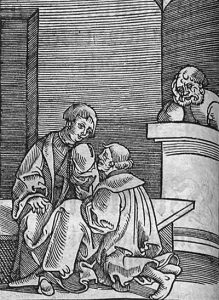
A penitent receives Absolution. Woodcut illustration for the Small Catechism by the Cranach workshop.