
A Meditation for Ascension Day
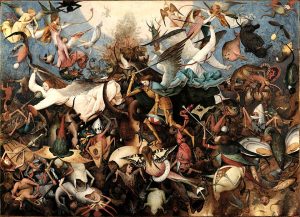
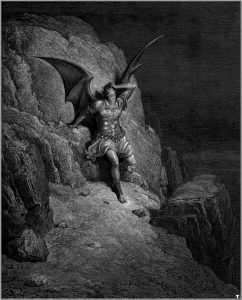 The works of Milton, Dante, and Bosch have cemented the idea that Satan and his fallen angels are in hell. Many Christians believe that Satan fell from heaven before the creation of man. However, Scripture paints a vastly different picture.
The apostle Paul in Ephesians chapter six refers to the fallen angels as “the spiritual forces of evil in the heavenly places” (Eph 6:12); and in chapter two, he specifically calls Satan the “prince of the power of the air.” (2:2) These are not just vague titles; as we will see, they refer to the demons’ place of honour – that is, dishonour – which they still maintain today. If we were to locate Satan and his angels, they are above our heads. Just below, but shut out of, God’s heaven.
For this to make sense, one has to understand the cosmic order. Like a human army, angels are organized into a hierarchy of rôles. Paul refers to different ranks of angels as “thrones”, “dominions”, “rulers”, “authorities”, (Col 1:15), and “powers” (Eph 1:21). We know of at least one archangel named Michael (Dan 12:1; Rev 12:7). Other angelic creatures, higher in station than even the archangels, are cherubim and seraphim. Chapter twenty-eight of Ezekiel seems to suggest that Satan was (or is) a “guardian cherub” (Ezek 28:14).
The book of Revelation gives us a description of Satan’s fall from heaven. “Now war arose in heaven, Michael and his angels fighting against the dragon and his angels fought back, but he was defeated, and there was no longer any place for them in heaven. And the great dragon was thrown down, that ancient serpent, who is called the devil and Satan, the deceiver of the whole world – he was thrown down to the earth, and his angels were thrown down with him.” (Rev 12:7-9)
When did this “war in heaven” occur? In the Gospel of Luke, Christ Jesus says: “I saw Satan fall like lightning from heaven.” (Luke 10:18) When He sent out seventy(two?) of his followers, Christ was watching the demons cast down from heaven. It happened during our Lord’s earthly ministry.
Scrolling back a ways. Yes, Satan had a seat in God’s heaven up until the time of Jesus. Thousands of years before Christ, in the time of the patriarch Job, we are told: “there was a day when the sons of God came to present themselves before the Lord, and Satan also came among them. The Lord said to Satan, ‘From where have you come?’ Satan answered the Lord and said, ‘From going to and fro on the earth, and from walking up and down on it.” (Job 1:6-7)
As an angel, Satan’s lawful place was in the heavenly court. Given what we know about his maverick nature, Satan went AWOL roaming the earth. Here we must know “satan” in the Hebrew language means “accuser.” Satan brings a charge against Job and against God’s saints “day and night before God” (Rev 12:10). That ugly business ended when Christ atoned for the sins of the world.
Christ took the accusation and the condemnation of the Law “to redeem those who were under the law, so that we might receive adoption as sons.” (Gal 3:5) Satan has lost his right of appeal in God’s court along with his heavenly rank.
Why does popular culture depict Satan in hell?
Hell – that is, the place of eternal judgment – is the place where God will confine His enemies. Although locked out of God’s heaven, they are yet to receive their full desserts. This is why the demons cower before Christ. The legion of demons who possessed the Gardarene demonic asked, “What have you to do with us, O Son of God? Have you come here to torment us before the time?” (Matt 8:29) “And they begged him not to command them to depart into the abyss.” (Luke 8:31)
Many will know of “the abyss” as a holding cell for evil spirits. Revelation chapter twenty depicts Satan being bound with chains and thrown into the abyss “so that he might not deceive the nations any longer, until the thousand years were ended. After that he must be released for a little while.” (Rev 20:2-3) Like the war in heaven described in chapter twelve of Revelation, the binding of Satan occurred during the earthly ministry of Christ.
Here is where things get messy.
Is Satan in the abyss now, or still in “the heavenly places”, where the Epistles clearly locate him?
Earlier we saw that Christians are adopted as “sons” (Gal 3:25). In the Parable of the Wheat and Tares, Christ refers to believers as “sons of the kingdom” (Matt 13:38). Fast-forward to the twenty-third chapter of Matthew, and Christ says to the Pharisees: “you travel across sea and land to make a single proselyte, and when he becomes a proselyte, you make him twice as much a son of hell as yourselves.” (23:15) That word “son” isn’t about origin but destination. It connotes an inheritance to be received in the future. Heirs, however, are always spoken of in terms of the present.
The apostle Peter writes to Gentile Christians that: “God did not spare the angels when they sinned, but cast them into hell and committed them to chains of gloomy darkness to be kept until the judgment” (1 Pet 2:4). The Greek word translated as “hell” is “Tartarus.” Here Peter is drawing a clear comparison. Every ancient Greek was told the story about how the titans fell from Mount Olympus and were being held prisoner in the lowest depths of Tartarus.
Satan and his angels are bound for eternal judgment. There is no escape for them. Their field of activity is the earthly sphere (Rev 12:12) – which, in the Hebrew mind, included the upper air, or “heavens” we can see with our eyes. They are essentially fugitives on the run from God’s heaven, the place we cannot see.
How does this square with Satan’s being bound? As we now know, he and his fallen angels are heirs of judgment. They are bound by destiny to hell. A grimmer prospect cannot be imagined. They exist in perpetual gloom, dreading the Final Judgment which may come at any moment.
Let’s try on their perspective. Imagine you’re a pampered palace brat. A son of the Emperor. All he has is yours to look forward to. Then, in one fell swoop, it is all snatched away from you. You’re banished from the seat of your father’s empire. You’re still a powerful prince. You take a few sympathetic retainers with you – or a lot – and carve out your own petty kingdom elsewhere. But it can’t measure up to what you had before. The Emperor has sworn to wipe you and your army out of existence like a bug from the window. Although it may seem like you’re well on your way, in your own mind, life is an unending prison sentence.
But it gets even worse for the devil. Imagine once more. You were once the heir to an empire, but find yourself outlawed and exiled. From the makeshift throne of your petty kingdom, at a distance but still too close for comfort to the imperial throne, you receive news that makes your skin crawl. Up to this point, you thought you couldn’t sink any lower. But you’ve just heard that the Emperor has appointed a new heir. Adding insult to injury, the new heir isn’t of the blood royal, but a lowly peasant. A peasant from among your enemies. But it gets even worse.
That peasant is coming in pomp and parade to claim his imperial throne, and he’s taking the long way around. His victory march will run right through your petty kingdom. He’s letting the bells ring and the banners fly. And it gets even worse.
The low-born Emperor marches right up to your castle door. He doesn’t knock like a gentleman. He kicks the door off its hinges and greets you with chains. Maybe even hooks should you make it harder on yourself. You know exactly how the song goes. Your reviled enemy requests your presence at his coronation ceremony – but you won’t be there as an honoured guest; you’ll be standing in shackles, a sideshow for men to jeer at. You’ve been utterly and completely undone.
As a final display, the low-born Emperor bids you and your most powerful earls to come before his throne. Again, you know the drill. In your day you’ve used it to humiliate your own enemies. Now you yourself are bidden to crouch down on all fours and spread your back so that the peasant-king may make you into a footstool. All this by your former father’s own design. (Ps 110:1)
Now, every metaphor breaks down. But take this as an allegory for Christ’s ascension into heaven – as well as His descent into hell. The apostle Paul in chapter four of Ephesians tells the Church: “Therefore it says, ‘When he ascended on high he led a host of captives, and he gave gifts to men.’ (In saying, ‘He ascended,’ what does it mean but that he had also descended into the lower regions of the earth? He who descended is the one who also ascended far above all the heavens, that he might fill all things.)” (Eph 4:8-10) This passage speaks of more than Christ’s omnipresence.
Being very nature God, He fills all things – from hell to heaven. Christ personally made a round trip to hell and despoiling it of any pride the demons might have taken in their lot. “He disarmed the rulers and authorities and put them to open shame, by triumphing over them in him.” (Col 2:15) There is no making “a heav’n of hell”.
So, Satan and his angels are directly overhead. They’ve fallen from heaven, and have further yet to fall when Christ returns to judge the living and the dead. For the time being, they have run of the upper air. They occupy the space between us humans and God’s heaven.
But keep in mind the heavenly hierarchy. God is at the top, the lower angels at the bottom rung. According to Christian tradition, then archangels; virtues; powers; principalities; dominions; thrones; cherubim and seraphim. Yet God Himself became man in Christ. Humanity is both beneath and above the angels. The first chapter of Hebrews: “to which of the angels has he ever said, ‘Sit at my right hand until I make your enemies a footstool for your feet?’ Are they not all ministering spirits sent out to serve for the sake of those who are to inherit salvation?” (Heb 1:13) 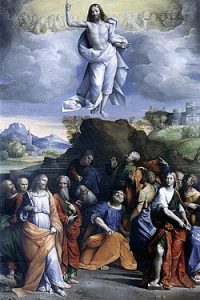
With all this in mind, the apostle Paul calls on the Church to lift up their hearts in Romans chapter sixteen: “The God of peace will soon crush Satan under your feet.” (Rom 16:19) Colossians chapter three: “If then you have been raised with Christ, seek the things that are above, where Christ is, seated at the right hand of God.” (Col 3:1) Philippians chapter four: “Finally, brothers, whatever is true, whatever is honorable, whatever is just, whatever is pure, whatever is lovely, whatever is commendable, if there is any excellence, if there is anything worthy of praise, think about these things.” (Philippians 4:8)
You cannot get any higher than Christ. No one can reach God without him – not with the help of any intermediary, human or angelic, certainly not by mysticism. The architects of the Tower of Babel had it wrong; they would have only met demons on their way up. You have to start at the bottom. The apostles and prophets are the foundation; Christ is the capstone. (Eph 2:20)
Ephesians chapter one: God “raised him from the dead and seated him at this right hand in the heavenly places, far above all rule and authority and power and dominion, and above every name that is named, not only in this age but also in the age to come. And he put all things under his feet and gave him as head over all things, to the church, which is his body, the fullness of him who fills all in all.” (Eph 1:20-23)
Satan looks up toward his lost heaven and sees – a man named Jesus of Nazareth. He is surrounded by lowly human beings like us. He has assumed the seat the devil once had in God’s court. Not accusing us before the Father, Christ is our “advocate” (1 John 2:1). Satan fell from heaven when He sent out His seventy(two) followers; after Jesus was born of the virgin Mary (Rev 12:1-6); when He arrived at Jerusalem as the Lamb of God, who takes away the sins of the world (John 1:29). In our Lord’s own words, “Now is the judgment of this world; now will the ruler of this world be cast out.” (12:31)
On Christ’s ascension I now build
The hope of my ascension;
This hope alone has always stilled
All doubt and apprehension;
For where the Head is, there as well
I know His members are to dwell
When Christ will come and call them.
(LSB 492:1)
